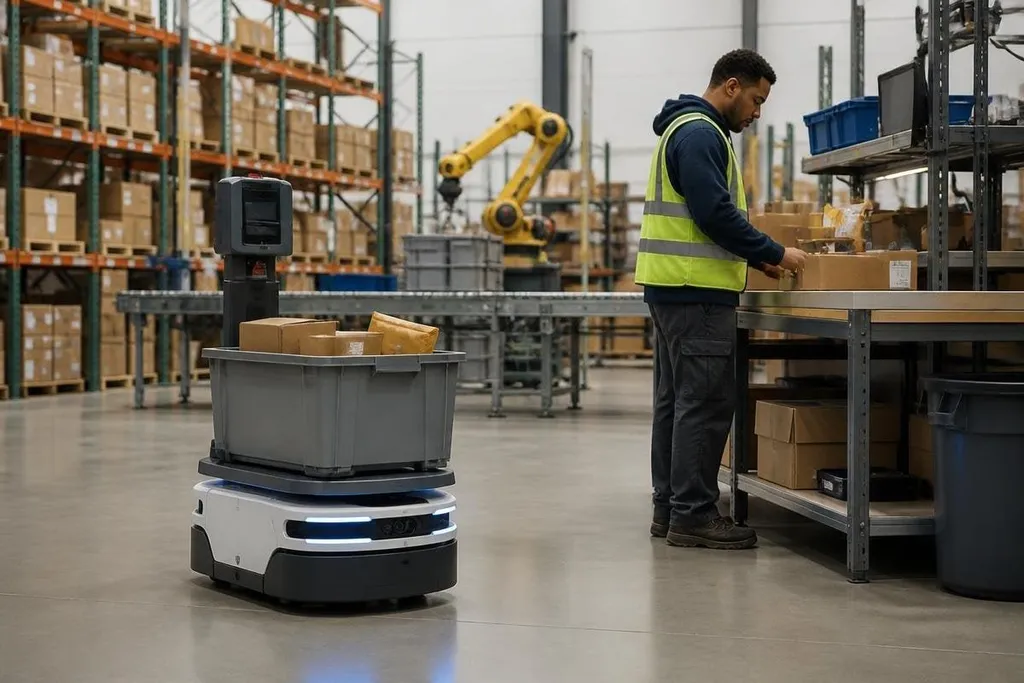
A warehouse robot can move a tote, scan a barcode, or bring a shelf to a packing station. It can't decide what to do when an order, package, or safety rule falls outside its software.
- Robots handle repeatable movement and scanning
- People deal with damaged goods, odd orders, and safety calls
- The first jobs to change are likely to be the most routine ones
What warehouse robots can do now
Most warehouse robots work inside a narrow task loop. An autonomous mobile robot, or AMR, follows a mapped route, avoids people with sensors, and carries goods between fixed work areas. A conveyor system moves boxes along a set path, while a robotic arm can pick items that fit its gripper and camera view.
That setup works when the items, routes, and handoffs stay predictable. A barcode gives the system an exact identity. A warehouse management system gives it a destination. The robot then repeats the movement without needing a person to push a cart across the same aisle.
The limits appear when the physical world stops matching the stored data. A crushed carton may hide its barcode. A soft bag may fold around another item. A pallet may sit across the route. The robot can stop and ask for help, but it can't repair the carton or decide if the order should ship.
The work people will keep doing
Warehouse work includes more than carrying products. People check stock, fix packing errors, remove unsafe items, handle returns, and make decisions when the software lacks enough information. Those jobs need sight, judgment, and a way to deal with exceptions.
A gripper may pick a boxed product from a known location. It may fail when the box has shifted, the shelf is partly blocked, or two items touch. A worker can move the products, inspect the label, and restart the task after finding the cause.
That division can change the shape of a job without removing the job itself. A picker may spend less time walking and more time watching a workstation, clearing blocked paths, or checking orders that the robot sends aside.
Why job numbers are hard to predict
One site may add robots because it needs more orders handled with the same floor area. Another may buy them because it can't fill night-shift roles.
A third may test one robot in a single aisle and stop there if the system creates too many delays.
The robot count alone tells you little. You need to know which tasks moved to a machine, how often a person must step in, and what happens when the robot stops. A system that carries goods for eight hours but needs a worker beside it for every handoff has changed the job, not removed the worker.
A useful warehouse robotics report names the robot, task, site, and human handoff behind a labor-saving claim. That evidence lets you judge if the machine removed work or shifted it onto people before the next section looks at the jobs under pressure.
The first jobs under pressure
Routine transport is the easiest work to hand to a machine. The same is true for fixed scanning points, empty-pallet movement, and repeated sorting where items arrive in known shapes.
Jobs with changing layouts and unusual goods are harder. A worker handling returns may face a wet box, a missing label, or a product that no longer matches the order record. Each case needs a choice before any machine can act safely.
Training will shift as well. A worker may need to read a robot alert, clear a sensor view, replace a battery, or check a digital route. Those tasks call for practical instruction, not a promise that the robot will run without help.
A practical test for your warehouse
Before treating a robot project as a headcount plan, check the work in this order:
- List the repeated motion. Write down each route, lift, scan, or sort step that happens the same way every time.
- Count the exceptions. Record damaged goods, blocked paths, missing labels, and manual overrides during a normal shift.
- Name the human decision. Mark the point where a person checks safety, quality, stock, or the order record.
- Price the full system. Include software, layout changes, service, charging, training, and the staff needed when a robot stops.
- Run one measured task. Compare completed orders, stoppage time, and worker time before expanding the system.
I'd treat any claim that robots will remove warehouse workers as incomplete until it names the task and the exception rate.
The likely result is a smaller share of walking and lifting, with more work around control, repair, checking, and unusual orders. The open question is how many warehouses will train people for those tasks before the machines arrive.